MTI
  • Home
    • Services >
      • Master Trainer Programme
      • Master Facilitator
      • Powerful Presentations
      • Mastering Middle Leadership
      • Innovation
      • Teambuilding Workshop
      • Team Effectiveness Review
      • Communication Skills
      • Focus on Training
      • Transforming the Trainer
      • Request Information
  • Get started - Resources
  • More...
    • Testimonials
    • What We Do
    • Case Studies
    • Expert Advice & Help
    • Teams
    • Individuals
    • Meet the Crew
    • How To Find Us
    • History of MTI
  • Blog
  • Home
    • Services >
      • Master Trainer Programme
      • Master Facilitator
      • Powerful Presentations
      • Mastering Middle Leadership
      • Innovation
      • Teambuilding Workshop
      • Team Effectiveness Review
      • Communication Skills
      • Focus on Training
      • Transforming the Trainer
      • Request Information
  • Get started - Resources
  • More...
    • Testimonials
    • What We Do
    • Case Studies
    • Expert Advice & Help
    • Teams
    • Individuals
    • Meet the Crew
    • How To Find Us
    • History of MTI
  • Blog
Search by typing & pressing enter

YOUR CART

Our thoughts and ideas about 
middle leadership and management

Our latest published middle leadership articles, posts and sometimes random thinking will be ​added along with
some items from before
 

Paragraph. Cliquer ici pour modifier.
30/1/2024 1 Comment

Earning trust as a leader

Seth Godin’s recent blog post says that when you are in a leadership position you are in a command-and-control situation. “You get to tell people what to do.” This is the way many see it.
 
Seth argues that a better way is to align with the people you lead. This can be seen on hundreds posts on here. And a lot of us agree with that.
 
“Trust and the benefit of the doubt are more powerful and resilient than command and control.
It’s more difficult to earn this leadership role, and more valuable once you have it.”
 
How do you earn trust?
When do you arrive a place where your team and your managers give you the benefit of the doubt? As Seth says, these are harder to earn but once you get there, they are far more valuable.
 
Have a look at what we have posted here. It isn’t meant to be a simple “Top 5” type of list, but some starting points to think of the difficulties. A lot will depend on the people you work with and your organisation’s culture. That’s why we never claim that this is the ultimate problem solver.
 
The problems can only be solved when adapted to where you work because you know the dynamics.
 
How can you:
Gain the trust of your team?
 
By being fair. This includes being aware of perceived favouritism.
BUT - You’ll get some jealousy from people who think you are favouring a particular colleague. Avoid it.
 
Having team members’ backs.
BUT - get this wrong and the trust you have earned from your managers could be blown away. this can be difficult and not seen as a right.
 
Encouraging input into decision making.
BUT - only if you don’t always ignore the suggestions!
Too often we hear of people who are regularly encouraged to come up with ideas, only to have their managers do the opposite – or the thing they were going to do anyway.
 
Address any concerns promptly.
BUT – this is where your prioritising skills come into play. Be aware that is often the case that a team member will think their problem is more important than someone else’s. 
 
Lead by example. Be a good role model.
BUT – this is exhausting and what you are modelling might not be a good fit for your team because they are doing a different job. For example, being positive and always enthusiastic about your work might be fine for someone with a nice office, company car and international travel but not so easy for the frontline workers who are working in a booth and dealing with irate customers.
 
Trusting your team. Delegating responsibility is a common strategy to show this.
BUT – you’ve got to get this right. Do you have the authority to delegate? Does everyone want responsibility? Are colleagues going to be happy with extra workload? Unlikely.
 
The next thing to look at is how you gain the trust of your leaders.
 
1 Comment

24/1/2024 0 Comments

How we can help anyone in a middle leader position

Here is a sample of the issues we solve. Your's not in the list?
Tell us what you need to make your work more effective.


Leadership Styles in Middle Management
  1. Transformational Leadership
  2. Transactional Leadership
  3. Servant Leadership
  4. Charismatic Leadership
  5. Laissez-Faire Leadership
  6. Collaborative Leadership
  7. Situational Leadership
  8. Adaptive Leadership
  9. Authoritative Leadership
  10. Democratic Leadership

Strategic Decision-Making in Middle Leadership
  1. Strategic Planning
  2. Decision Analysis
  3. Risk Management
  4. SWOT Analysis
  5. Decision Criteria
  6. Scenario Planning
  7. Cost-Benefit Analysis
  8. Data-Driven Decision Making
  9. Strategic Alignment
  10. Decision Implementation

Team Building and Collaboration for Middle Managers
  1. Team Dynamics
  2. Team Building Activities
  3. Collaboration Tools
  4. Conflict Resolution
  5. Effective Communication
  6. Trust Building
  7. Team Diversity
  8. Team Performance Metrics
  9. Empowering Teams
  10. Building a Positive Team Culture

Effective Communication in Middle Leadership
  1. Communication Styles
  2. Active Listening
  3. Clear Messaging
  4. Feedback Mechanisms
  5. Interpersonal Communication
  6. Conflict Resolution Communication
  7. Nonverbal Communication
  8. Cross-Cultural Communication
  9. Communication Channels
  10. Communication Strategy

Conflict Resolution in Middle Management
  1. Conflict Management Styles
  2. Negotiation Techniques
  3. Mediation in Conflict Resolution
  4. Conflict Resolution Models
  5. Addressing Interpersonal Conflicts
  6. Cultural Sensitivity in Conflict Resolution
  7. Managing Team Conflicts
  8. Conflict Prevention Strategies
  9. Conflict Resolution Training
  10. Emotional Intelligence in Conflict Resolution

Emotional Intelligence for Middle Leaders
  1. Self-Awareness
  2. Self-Regulation
  3. Motivation
  4. Empathy
  5. Social Skills
  6. Emotional Intelligence Assessment
  7. Emotional Resilience
  8. Emotional Intelligence in Leadership
  9. Emotional Intelligence Training
  10. Emotional Intelligence and Decision Making

Time Management and Prioritization in Middle Management
  1. Time Blocking
  2. Priority Setting
  3. Task Delegation
  4. Procrastination Management
  5. Time Tracking Tools
  6. Time Management Techniques
  7. Urgent vs. Important Tasks
  8. Time Management Training
  9. Work-Life Balance
  10. Time Efficiency Strategies

Change Management at the Middle Leadership Level
  1. Change Leadership
  2. Change Models
  3. Change Communication
  4. Employee Resistance
  5. Change Implementation
  6. Change Readiness
  7. Change Agent Role
  8. Change Management Frameworks
  9. Organizational Change Culture
  10. Continuous Improvement

Developing and Motivating Teams in Middle Management
  1. Employee Motivation
  2. Team Empowerment
  3. Recognition and Rewards
  4. Team Development Plans
  5. Motivational Leadership
  6. Employee Engagement Strategies
  7. Employee Satisfaction
  8. Talent Development
  9. Team Building Initiatives
  10. Incentive Programs

Performance Evaluation and Feedback for Middle Managers
  1. Performance Metrics
  2. Goal Setting
  3. Continuous Feedback
  4. Performance Appraisal
  5. Key Performance Indicators (KPIs)
  6. Performance Improvement Plans
  7. 360-Degree Feedback
  8. Objective vs. Subjective Evaluation
  9. Performance Management Systems
  10. Employee Development Plans


0 Comments

20/1/2024 0 Comments

When your line manager is a bully, what do you do?

Picture
You know those LinkedIn ‘thought leaders’?
 
The ones, ironically, who don’t have a single thought of their own, just repost endless tripe about a perfect world?
​ “The best leaders do this. The best leaders do that”.


Classics like:
“See someone else’s strength as a complement to your weakness, not a threat.”

 “Be a leader, not a boss”

Okay, I may be too harsh and they mean well, but they are not helping anyone whose boss is unpleasant. And they are out there!
I had a sales manager who had the reputation of being a nasty piece of work.
They absolutely saw someone with strengths as being a threat. They gloried in being in charge, giving orders to do things their way – being the boss.

And it is across the board.

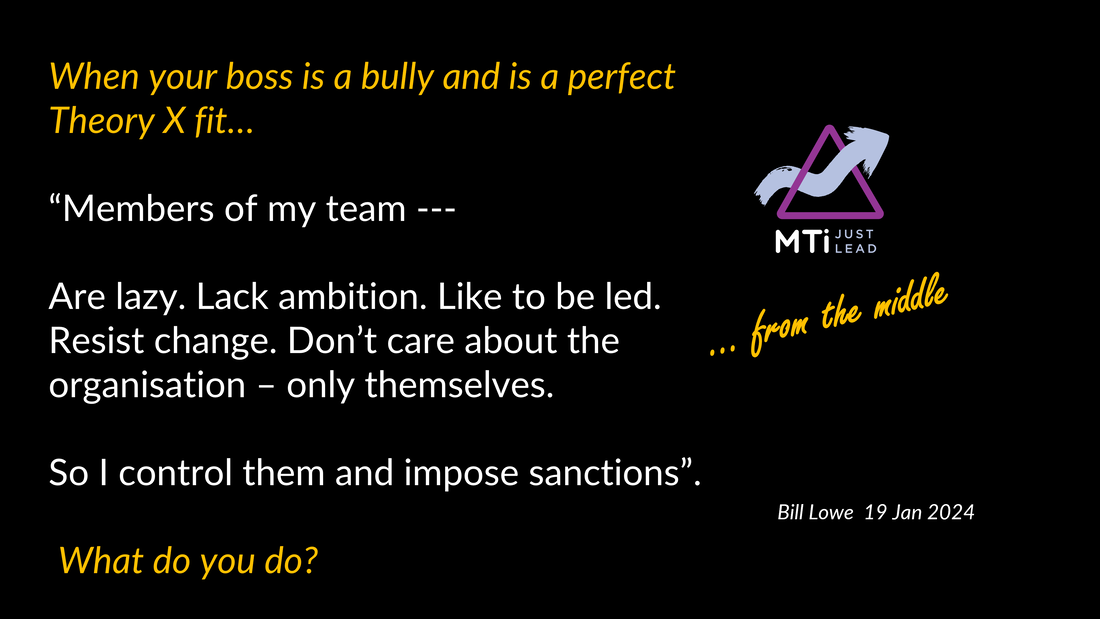
Students on the Leadership and Management MA I run, work in health, education and industry. They all report the nasty boss. McGregor's Theory X is alive and well.

Briefly, Theory X managers say things like:
“Members of my team are lazy. Lack ambition. Like to be led. Resist change. Don’t care about the organisation – only themselves.
So I control them and impose sanctions”.

Whilst it’s pretty clear that a well-motivated and respected workforce will produce better results than a down-trodden one, don’t believe for one second that everyone agrees with this.

Good advice, from people like us, will often suggest taking things to HR, checking the organisation’s policies around workplace well-being and whistleblowing procedures and protection. Very good.

But what if you work in a smaller set-up where there is no HR department or where your unpleasant leader is on close terms with the most senior management?
What I’m saying here is you can follow all the good advice but still not get anywhere. Or even make things worse.

So what can you do? What should I have done, back in the day?

Seek support: Talk to close colleagues. You could find that they are or have been in a similar situation. Have word with friends, or family about your experiences. They can provide a level of emotional support that you might not get at work. Also they offer valuable perspectives.
Take care to not discuss the issue with any co-workers who aren't too good at keeping things confidential. You'll know the ones!
 
Be professional: Keep doing your job to the best of your abilities and don't take your frustrations out on other colleagues. Be sensitive to this if you are a middle leader. Do not kick downwards.
 
This will help you maintain a positive reputation within the organization and  be particularly useful when evaluating your options. For example, if the things get unacceptable you may need to consider working somewhere else. Keeping them on-side now will be good. Antagonising them could lead to you having a poor reference.

Why get trapped working in a place where your concerns are not addressed? It is not worth it.


0 Comments

20/1/2024 1 Comment

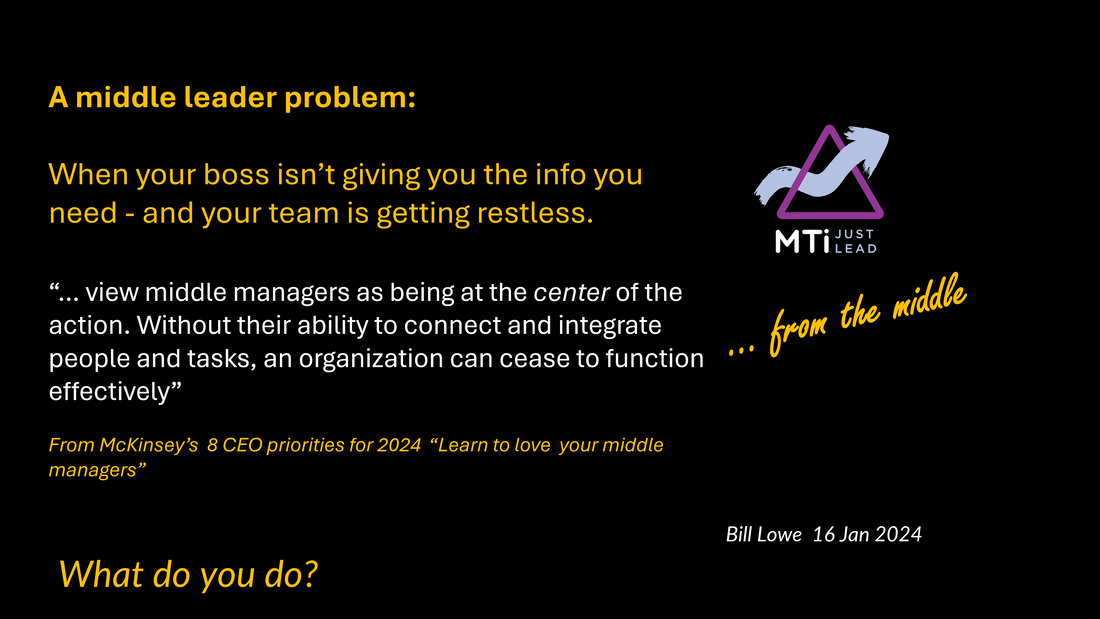
When your boss is slow passing on info... and your team is getting restless

Picture
​Things like performance review data, new targets, KPIs... your team is expecting important data. They are waiting for you to send it but you have not been given it or maybe you haven't had the permission to release it yet.

Your team nag you and start getting uneasy - understandably.

How much can you nag your boss?
Do you tell  your team what the delay is?
Do you stay loyal to your boss and cover their slowness?

Connecting people and tasks is a regular issue we hear about and help to solve. Communication flow is probably the Number One gripe we get from middle leaders. In particular: when they are waiting to pass on some information to their team, but this hasn’t been released by those higher up.

This raises questions:

Are senior managers holding back for a legitimate reason or are they just being slow?

Are they being slow because they don’t appreciate the urgency, or that they don’t care?

How does the middle leader approach them? Or can they?

What does the middle leader say to their team? Do they criticise the senior leaders? Do they stand up for them? Do they openly empathise with one side or both?

 
A lot depends on the culture of where you work and its different expectations. So have this in mind when we suggest this as a starting point when keeping your team notified:

"I totally understand how frustrating it is for you. I am in the same position. I am in regular contact with the senior team and have let them know that a quick resolution will be appreciated by all of us. They are not being awkward but only want to ensure that the information is accurate."
The important thing here is letting your team know that their criticism has been noted. They are not being ignored.
But what if you believe that your requests are being ignored by your manager?
That's something for next time. Any ideas?
If you want to contribute but prefer to keep it out of your manager's sight, send a PM.
1 Comment

20/1/2024 1 Comment

When Middle Managers and Leaders Don't Sign Up for the Role

There's been an increase in articles about middle leaders and managers who are promoted but don't really want the job. Sometimes they are referred to as "accidental leaders".

It's  common.

The problem is often caused by organizations who want to reward their talented employees,  but the money is not available unless that person is promoted to a leadership and management pay scale.

A key factor is not everyone is cut out to lead people or prepared to do so but they find themselves having to. Turning down the chance of a pay increase is a tough decision for a lot of us.

It's a tricky one because good organizations want to recognise and reward their best performers . But get it wrong and the damage can be significant.

For example, you will be taking a high performer away from what they are good at. Can they be replaced by someone as good? Difficult in the short-term, that's for sure.

Then what about the damage caused by their inadequate leader and manager skills?

This can wreck team performance, and cause resentment among team members.

How can we sort this out?

Find out if there is any way of transferring funds from the leadership and management budget to enhance a higher band of non-management workers. Okay. I can hear the howls of laughter! But has anyone asked? Or are expectations of this too low- do you know?


Avoid it in the first place

  • Check if potential leaders are comfortable with the expectations of their new role.
      e.g. Will they be confident about dealing with conflict or delegation?
If they aren't then it's a red flag. Will a leadership preparation programme be the answer, or is it deeper than that?


​What if they are already in the job?

  • Identify  training that fits their specific needs. Again, will this be enough?
  • Don't overload them with too many direct reports; let them focus on what they're good at. Could this be retaining a good part of the week still carrying out frontline work and cutting back on the leadership side?
Watch out here. This often leads to a massive overload if not managed carefully.

Recognition without being promoted to manager: In larger organisations it might be possible give these star performers a training role across other departments and branches.
This is proper Change Agent work.

This will be enhanced by sending them to national conferences. Maybe even international ones. They are your organisation’s representatives. They can have a prestigious title like Global Ambassador.

The next impact will be allowing them to feedback to key personnel about the conference.


As usual, we are not trying to give a list of perfect answers. These are starting points for discussion and thought.

​If none of our ideas will work for you, that's cool. But let's modify and adapt to your workplace.
1 Comment

20/1/2024 1 Comment

From strategic drawing board to frontline application

Picture
​Middle leaders: not just a conduit but people who can shape the culture of an organisation. From strategic drawing board to frontline application.
Middle managers are often seen as a conduit between C-suite and frontline. But this isn't utilising them enough. The brightest people in the middle can bring a whole new perspective to things.

Understandably, those at the top are required to have a broad, strategic view. It's in the job description. Middle leaders can tease out the intricate details and make them clear to those at the top. This will help senior managers make decisions that will work.
Done properly, it is a perfect jigsaw.
But it can only work if:
senior managers allow and encourage these conversations
middle managers have the trust of the frontline
middle managers have the communication skills to put their case


Sylvia Rohlfer, Abderrahman Hassi and Simon Jebsen point to research that suggesting empowered followers take a more proactive approach to what is happening at work. Bosses who encourage this benefit from team members coming up with things that senior staff might not think of.

A danger I can see is when leaders at any level feel threatened by what might seem to be a loss of control. It goes further.
In Global Leadership Perspectives, Asha Bhandarker and Pritam Singh highlight the evidence that millennials - and, I now suggest Gen-Z employees are looking for their managers to be more like coaches and mentors rather than order-givers.
All this suggests that we are heading for a time when the traditional top-down autocratic approach does not work.
Is this a new role for middle leaders: being the coach and mentor that helps the senior management's strategic message get put into practice?

1 Comment

20/1/2024 1 Comment

Authenticity and middle leaders

‘Fight for your team’ seems a magnificent thing to do. Commendable.
But as an increasing number of posters here have said: unrealistic.

It is the classic middle leader dilemma.

But there’s no reason they can’t ask their seniors to be very clear about why they are issuing instructions or introducing initiatives. Suggesting that clarity is needed in order to enhance deliverability by reducing friction is a possible way forward.

It is not confrontational, it’s setting out your aim of making things work.

The best middle leaders will predict what their team will need to know. If they don’t, they will find out.

It’s about being authentic. This is not simply about fighting for your team, but having an acute  grasp of senior management’s perspective as well. Expectations in both directions should be agreed and genuinely understood.

Not sure about expectations? Find out. edit.
1 Comment
    Picture

    Author

    Bill Lowe. Leadership and learning researcher, author and trainer.

    Archives

    July 2025
    June 2025
    March 2025
    February 2025
    June 2024
    January 2024
    November 2023
    August 2023
    November 2022
    October 2022
    September 2022
    April 2022

    Categories

    All

    RSS Feed

Powered by Create your own unique website with customizable templates.